A no-bullshit introduction to groups: Part 1.
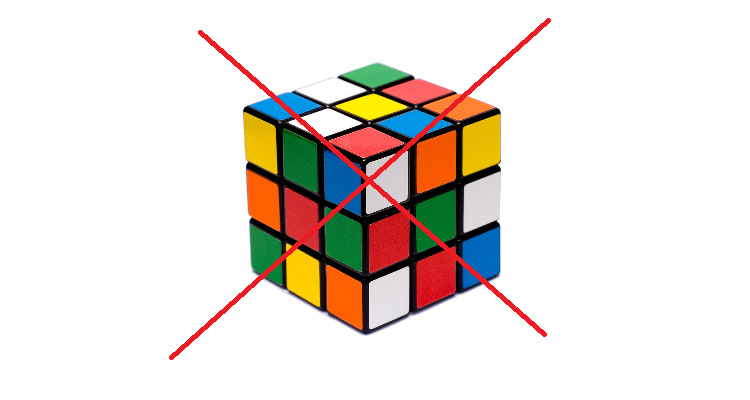
Many years ago, back when I was in my early teens, I picked up an interest in math. Arguably much more superficial than it is now. My gateway drug to discovering abstract algebra was a YouTube video about the unsolvability of the quintic.
Of course, I didn’t understand shit after watching it. I think that I got lost somewhere midway the video, where the author decided that the best idea is to keep on with the “graphical” and “friendly” explanation of groups by rotating cubes or balls, and explained the rest of the concepts in this insurmountably confusing and pointless way. It must’ve sucked to be me, because every exposition of basic group theory was either that, or needless complexity galore that required much more mathematical maturity than a 13 year old could’ve spared.
When I was procrastinating working, now - give or take - 8 years later, I saw another pointless rehashing of the same topic in the same pointless logical framework. So I thought that maybe I can do a better job.
What is a group?⌗
Suppose that you have a set. Of anything, really - potatoes, dodgeballs, whatever. Actually, who am I lying to? Just take non-negative integers smaller than 4. Call it .
Now suppose that you have an action (for potatoes it could be mashing, for dodgeballs - this, for integers - addition modulo 4) that you can perform on any two elements of that set, and that action (call it - like the product operator) has the following properties:
- for any (associativity).
- There exists an element such that for any , (identity element).
- For any , there exists an element such that (inverse element).
From here it should also be clear that (closure; i.e. maps two elements of to another element of ). Then the pair is called a group.
So in our example, and is addition modulo 4. The identity element is 0, because adding 0 to any number doesn’t change it. The inverse of 1 is 3, because ; the inverse of 2 is 2, because ; and the inverse of 3 is 1.
So here we discover one of the most straightforward families of groups: integers modulo form a group. Formally speaking,
is a group for any integer .
What is this useful for? You could model a hand of a clock with it, for example. What happens when an analog clock shows 10:35 a.m. and you add 50 minutes to it? It shows 11:25 a.m. In other words, .
Simplest example of a group is when we set , a set with a single element, and define such that . This group is called the trivial group.
Exercise: It easily follows that is a group. Is a group? Don’t skim over this. Try to informally prove or disprove it. Would this construction violate any of the group properties?
Bijections and the group of bijections.⌗
A bijection is essentially a function that maps elements from one set to another in a one-to-one manner. In other words, no two elements from the first set map to the same element in the second set, and every element in the second set has a corresponding element in the first set.
For example, we can define a bijection between and as follows:
We see that is a bijection, because every natural number maps to a unique integer, and every integer has a corresponding natural number. We can also invert this mapping to get .
As another example, we can define a bijection that maps natural numbers to even natural numbers as . Detour: It may seem a bit illogical: after all, aren’t there more natural numbers than even natural numbers? Infinite sets are a bit tricky to reason about. In mathematics we would say that both sets have the same cardinality (because there is a bijection between them), but they have a different density (because even natural numbers are less frequent in the set of natural numbers).
Now, let’s take our newfound group powers. The group is the group of all bijections from a set to itself, with the group operation being function composition. So for some set , and the group operation is defined as for any and .
Is this actually a group? Well, go and check: the function composition is associative, the identity function serves as the identity element, and every bijection has an inverse function that is also a bijection. Furthermore, if are bijections then so is , so the closure property holds as well.
How to demonstrate this formally, axiom by axiom:
Axiom 1: Notice that for any functions and any , we have: . Since the two compositions agree on every , . So (more generally) composition is associative on the set of all functions from to .
Axiom 2: Define by . This map is bijective. For any bijective and any , we have Hence is an identity element.
Axiom 3: Let be a bijection. For each there exists a unique with . Define by “ the unique such that ”. This is a well-defined function. Then for any , , so , i.e. . For any , , so , i.e. . So is bijective (its inverse is ).
Closure: This is proven by first working forwards (prove that the composition of two bijections is injective) and then backwards (prove that the composition of two bijections is surjective). You can find a trillion proofs of this online.
Homomorphisms⌗
A homomorphism is a “structure-preserving map” between two groups. What a useless definition. Take two groups, and . A homomorphism from to is a function such that for any , .
Example: shows that the natural logarithm is a homomorphism from the multiplicative group of positive real numbers to the additive group of real numbers .
Important: an isomorphism is a bijective homomorphism. In other words, it’s a structure-preserving map between two groups that is also one-to-one and onto. If two structures are isomorphic, we write .
Example: The groups and are isomorphic via the natural logarithm function , which is a bijective homomorphism (inverse function is the exponential function ).
That’s it.
Subgroups⌗
A subgroup is a subset of a group that is itself a group under the same operation. Formally, if is a group and , then is a subgroup of if:
- For any , (closure).
- There exists an element such that for any , (identity element).
- For any , there exists an element such that (inverse element).
- For any , (associativity).
This is tricky, because we have to maintain closure, identity, inverses, and associativity.
Example: Consider the group . The set of even integers is a subgroup of because:
- The sum of any two even integers is an even integer (closure).
- The identity element 0 is an even integer (identity element).
- The inverse of any even integer is also an even integer (inverse element).
- Addition is associative for all integers, including even integers (associativity).
Cayley’s theorem.⌗
Every group is isomorphic to a subgroup of , the group of bijections of under composition.
We constructively demonstrate this below. For each , define left multiplication by as the map
Now:
- Each is a bijection: its inverse is .
- Composition matches multiplication:
- The map given by is a homomorphism.
- is injective, since .
Hence: is a subgroup of , and . Thus every group can be realized as a group of bijections.
Just as a simple example: Cayley’s theorem says that for where . Notice that here is not our invention: The theorem demands we take each group element and turn it into a bijection of the set onto itself by “left multiplication” (here, addition modulo ). So each element k of the group becomes the function “add k”. Every group element is doing something to a set, and group multiplication is just doing those things one after another.
The image is the set of functions
This is a subset of , and it is closed under composition:
This is about the right time to explain symmetric groups: the symmetric group on a set , denoted typically taking , is the group of all bijections from to itself under composition. The order (number of contained elements) of the symmetric group is , which counts the number of ways to arrange distinct elements.
See the link already? An alternative concrete rephrasing of Cayley’s theorem is that every (finite) group of order is isomorphic to a subgroup of the symmetric group .
Cosets⌗
Suppose that is a group and is a subgroup of (stated tersely as ). For any element , the left coset of in with respect to is the set . Similarly, the right coset of in with respect to is the set .
Basic facts:
- Every element of belongs to some left-coset.
- Two left-cosets are either disjoint or identical.
- All left-cosets of in have the same number of elements as .
Cosets, vaguely speaking, are useful for partitioning groups. Given a group and a subgroup , we let:
be the set of all left-cosets of in . Now suppose that we wanted to turn this set into a group. For this purpose, we want to define:
However, this definition is only valid if it doesn’t depend on the choice of representatives and . In other words, if and , we need to ensure that . From we get , and from we get . Thus, for the operation to be well-defined, we need:
And thus we see , but it is conjugated by :
For this product to be in , we need to be invariant under conjugation by any element of , i.e. for all . Such subgroups are called normal subgroups (denoted ).
So now if we augment with the operation , we get a group called the quotient group.
This is a well-defined, pretty regular, group:
- Identity:
- Inverse:
- Associativity inherited from
This construction has a very special purpose: it is the only way groups can be simplified without losing structure.
First Isomorphism Theorem⌗
Suppose that is a homomorphism between two groups and . The kernel of is the set , where is the identity element of . The image of is the set .
As a simple example of a kernel, consider the homomorphism defined by . The kernel of this homomorphism is the set of all integers that are multiples of , i.e. - because (informally) these are the integers that map to 0 in .
We know for a fact that the kernel of a homomorphism is always a normal subgroup of the domain group. In our example, is indeed a normal subgroup of . Furthermore, is injective if and only if , where is the identity element of .
As an example of an image, consider the same homomorphism . The image of this homomorphism is the entire group , i.e. - because every element in can be obtained by taking some integer modulo .
The structural theorem (or the First Isomorphism Theorem) states that if is a homomorphism, then the quotient group is isomorphic to the image of , i.e. .
Constuctively we can define a map by . This map is well-defined, because if , then , which implies that , and thus . The map is a homomorphism, because: The map is surjective by definition of the image, and it is injective because if , then , which implies that , and thus .
Intuitively: A homomorphism collapses elements of G that differ by elements of the kernel. Once you factor out exactly this redundancy, what remains is structurally identical to the image.
Going back to our example with , we have and . According to the First Isomorphism Theorem, we have: This means that the quotient group is structurally identical to the group , and we can give an explicit isomorphism between them:
It’s useful to visualize the algebraic structures at hand a little bit:
- is the subgroup of consisting of all multiples of , i.e. .
- The quotient group consists of the cosets of in , i.e. . There are exactly distinct cosets, which can be represented by the integers .
In , an element is not a single integer, but rather a set of integers that differ by multiples of . For example, the coset includes all integers of the form for any integer . Addition is defined as: Making it a group (check the propeties!).
Tying the knot.⌗
A group is simple if it has no normal subgroups other than the trivial group and itself . Simple groups are like the prime numbers of group theory - they cannot be broken down into smaller, non-trivial normal subgroups.
The factorisation lets us analyse complex groups by breaking them down into simpler components. This is the essence of the Jordan-Hölder theorem. A composition series of a finite group is a sequence of subgroups:
where each is a normal subgroup of , and the quotient groups are simple groups. The Jordan-Hölder theorem states that any two composition series of a finite group have the same length and the same simple quotient groups, up to isomorphism and order.
Detour: Applications of the First Isomorphism Theorem⌗
An integer is called a quadratic residue modulo if it is congruent to a perfect square modulo ; in other words, if there exists such that .
When the number is prime, it has quadratic residues. This is a pretty elementary result in number theory, but we can also prove it elegantly using the First Isomorphism Theorem:
Let be the group of integers modulo under addition, and let be the group of invertible elements of under integer multiplication (i.e. ). Define the group homomorphism by . The kernel of is the set of all such that , which is (or ; both follow from the fact that is prime).
By the First Isomorphism Theorem, we have: Hence:
Which concludes the proof.
It’s quite magical, so anticipate to sit with this for a while. This theorem lets us prove that if is prime and , then quadratic probing will always find a vacant bucket, and furthermore, no buckets will be checked twice.
Classification of finite groups, algebraically.⌗
A finite simple group is isomorphic to exactly one of the following:
- A cyclic group of prime order, i.e. for some prime .
- An alternating group for some .
- A group of Lie type (finite groups of -rational points of simple algebraic groups over finite fields , modulo center plus twisted forms):
- Classical groups: , , , .
- Exceptional and twisted groups: , , , , , , , , , .
- One of the 26 sporadic groups.
Every group is some gluing and extension of these (this is actually a pretty impressive result!).
Alternating groups.⌗
Not really super related to our topic, but alternating groups kind of interesting. Recall that is the group of all bijections of the set , with group operation given by composition.
There exists a surjective group homomorphism whose kernel has index 2 (the kernel is half the size of ). We do not need to construct explicitly; its existence is a theorem.
We define the alternating group to be exactly this kernel:
By general group theory we notice that:
- (normal subgroup).
- (index 2).
- (order).
- Finally, per the First Isomorphism Theorem, we have - important!
The unremarkable cases are as follows:
is the trivial group; we see that definitionally , so .
is also the trivial group; , so .
is isomorphic to ; has 6 elements, so has 3 elements. It can be verified that .
To explain , we must first expose Lagrange’s theorem and Cauchy’s theorem. Lagrange’s theorem states that for any finite group and any subgroup , the order of divides the order of . In other words, , where is the index of in (the number of distinct left cosets of in ).
The proof of Lagrange’s theorem is straightforward: the left cosets of in partition the group into disjoint subsets, each of size . Therefore, the total number of elements in is equal to the number of left cosets multiplied by the size of each coset, which gives us . From this equation, it follows that divides .
Cauchy’s theorem states that if is a finite group and is a prime number that divides the order of , then contains an element of order . Consequently, also contains a subgroup of order . We will adjourn the proof of this for later, because it’s a little involved.
Now, has 12 elements. By Lagrange’s theorem, the possible orders of subgroups of are 1, 2, 3, 4, 6, and 12.
To decide which of these orders actually occur, we will use Cauchy’s theorem: , so there exists such that . Pick as such element. Then, is such a subgroup of order 2.
If the group had one element of order 2, then the subgroup would be normal and the quotient would have order 6, which is impossible because . If there were more than three such elements, then their pairwise disjointness would imply that has more than 12 elements. Therefore, there are exactly three elements of order 2 in , which we can denote as , , and .
Now we can form the subgroup: where are the three elements of order 2. Inverses are automatic, closure holds because the product of any two elements of order 2 is the third element of order 2 (e.g., ), and the identity element is included; further the associativity is inherited from .
As a direct result, we see that the quotient group has order 3. We can prove that (exercise for the reader). Taking the kernel of the action , we see that and (Lagrange’s theorem). Since , then . Since , , so is either 3 or 6. If it were 6, then this would give a subgroup of order 2 in arising as a quotient of , which is impossible because the image of under the action must fix a coset. Hence , so and therefore . Since is normal in , we have shown that .
This is enough to conclude via the first isomorphism theorem that , giving us a non-trivial normal subgroup of that proves that is not simple.
As a side note, here is the Klein four-group, often denoted or just . It is isomorphic to the direct product .
Starting with , the alternating groups become simple. One stanard presentation is as follows:
This means that is generated by two elements and with the relations , , and .
Via Cayley’s theorem we let act on itself by left-multiplication. This gives a homomorphism defined by for all . Since has 60 elements, is isomorphic to .
The characterisaton of these groups for is hard as heck, and I don’t know how to do this myself. So we will just leave it at that: for , the alternating group is simple.
Detour: Burnside’s lemma⌗
The amount of binary sequences of length distinct under cyclic shift is given by:
This is super useful when analysing cyclic redundancy codes, like CRC-32 (who knew?).
A cyclic shift is a permutation of the vector to the vector . Cyclic codes (parent family of CRC-32 and others) are defined in such a way that the code is invariant under cyclic shifts, i.e. if is a codeword, then so is any cyclic shift of . We will avoid talking too much about that because it requires leaping to a different river of a topic (polynomial rings over finite fields).
Anyway, how come this formula works? A group is cyclic if there exists an element such that The cyclic group of order is Further, let the group act on a set . For any element , the orbit of is the subset: In other words: the orbit of is the set of all elements of that can be reached by applying elements of to .
Let be the set of binary strings of length . Define an action of on by letting the generator act as a one-step cyclic rotation: Then acts as rotation by positions, and acts trivially.
Two strings are equivalent under cyclic shift if and only if they lie in the same orbit of this action. Hence the number of distinct binary sequences under cyclic shift is the number of orbits (binary necklaces).
Burnside’s lemma says that for a finite group action , where
Applying this to over , we obtain
Thus it remains to compute .
Fix . A string is fixed by if and only if
Thus the indices are partitioned into cycles under the permutation and the string must be constant on each cycle.
Let . Consider the cycle containing : Its length is the smallest such that
Write , with . Then Since , this holds if and only if . Hence the minimal such is
Therefore:
- each cycle has length ,
- the total number of cycles is
On each cycle, all bits must agree, but different cycles may be chosen independently. Hence
Finally we substitute into Burnside’s lemma:
This completes the proof.
Burnside’s lemma (also seldom called Cauchy-Frobenius lemma) follows by noticing the following (as givne by Ben Lynn in Polya Theory):
Let the orbits be the partition of under the action of . Observe that the resulting sets for also partition . As such, we have:
By the orbit-stabiliser theorem and Lagrange’s theorem, we have , and hence the result follows.
Extra reading:
- Cauchy’s theorem (partial converse to Lagrange’s theorem)
- Sylow theorems (existence of subgroups of order )
- Orbit-stabilizer theorem; isotropy groups (here ).
Solvable groups⌗
It’s a little late to introduce this, but an Abelian group is a special type of a group where the group operation is commutative, i.e. for any , . That’s just an additional axiom on top of the group axioms.
We call a finite group solvable if there exists a finite sequence of subgroups: such that each is a normal subgroup of , and the quotient groups are Abelian groups. Equivalently, all (simple) composition factors of are cyclic groups of prime order.
There’s two immediate facts that we will state without proof:
- If is solvable, then every subgroup and every quotient group of is also solvable.
- If is a normal subgroup such that both and are solvable, then is also solvable.
Part 2⌗
Fields, automorphisms, Galois groups, extensions, fundamental theorem of Galois theory, solvability by radicals. One day.