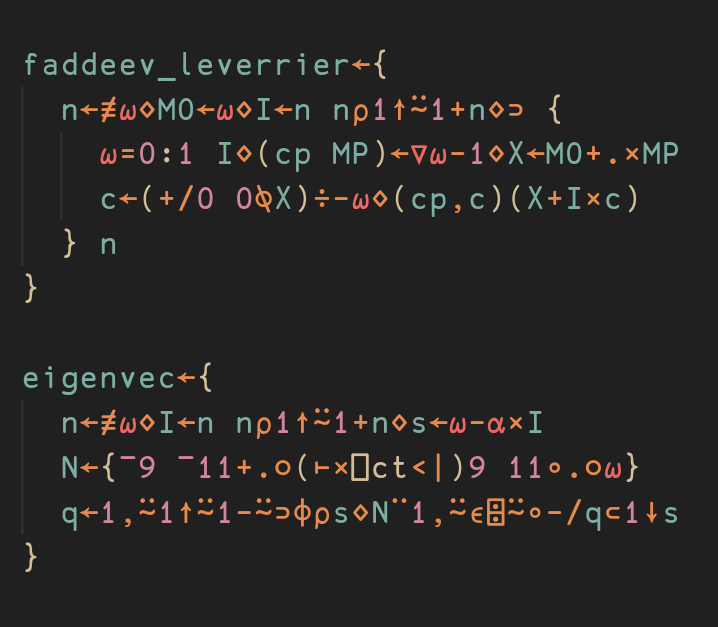
The Faddeev-LeVerrier algorithm is one of my favourite algorithms related to linear algebra for a variety of reasons:
- It's incredibly elegant
- It computes many things at once - the trace of a matrix, its determinant, inverse and the characteristic polynomial (and thus, its eigenvalues).
- The task of computing the characteristic polynomial usually requires the use of symbolic computation - one needs to compute
 to get a function of
  , while the Faddeev-LeVerrier algorithm can do it numerically.
Initial considerations ⎇
The objective of the Faddeev-LeVerrier algorithm is to compute coefficients of the characteristic polynomial of a square matrix.

The first observation to be made is that  and
and  . The algorithm states:

A few observations assuming a  by matrix
  :
:
 .
.- The trace of is equal to
 .
.  is equal to
  (a consequence of the previous observations about
  ).
). is equal to
  .
.
An implementation ⎇
I start my implementation by asserting a few things about the environment and the input:
faddeev_leverrier←{
  ⎕io ⎕ml←0 1⋄(≠/⍴⍵)∨2≠≢⍴⍵:⍬
}
I'm interested only in matrices (arrays of rank 2 - 2=≢⍴⍵) and I specifically want them square -=/⍴⍵. If the conditions aren't met, the algorithm returns an empty coefficient vector.
faddeev_leverrier←{
  ⎕io ⎕ml←0 1⋄(≠/⍴⍵)∨2≠≢⍴⍵:⍬
  n←≢⍵⋄M0←⍵⋄I←n n⍴1↑⍨1+n
}
Next up, I define n as the number of rows/columns of the input matrix, M0 as the starting matrix for the algorithm, and I as an identity matrix of order n. The actual recursive implementation of the algorithm will return a vector of the characteristic polynomial coefficients and the matrix corresponding to the current iteration. Since the matrix corresponding to the last iteration is simply n n⍴0 (per observation 1), I will discard it:
faddeev_leverrier←{
  ⎕io ⎕ml←0 1⋄(≠/⍴⍵)∨2≠≢⍴⍵:⍬⋄n←≢⍵
  M0←⍵⋄I←n n⍴1↑⍨1+n⋄⊃ {
    ⍵=0:1 I
  } n
}
I have also added a guard for the final iteration, which simply returns the identity matrix and 1 as the coefficient.
faddeev_leverrier←{
  ⎕io ⎕ml←0 1⋄(≠/⍴⍵)∨2≠≢⍴⍵:⍬⋄n←≢⍵
  M0←⍵⋄I←n n⍴1↑⍨1+n⋄⊃ {
    ⍵=0:1 I⋄(cp MP)←∇⍵-1⋄X←M0+.×MP
  } n
}
I recursively call the function asking for the pair of  and the corresponding
 c value. I also multiply matrices M0 (the input matrix) and MP (the previous matrix), as it'll prove itself useful in upcoming computations, first one of them being the computation of c for the current iteration. For this purpose, I take the trace of X and divide it by the negated iteration index. The dyadic transposition (axis rearrangement) 0 0⍉X yields the leading diagonal of X, while +/ sums it.
faddeev_leverrier←{
  ⎕io ⎕ml←0 1⋄(≠/⍴⍵)∨2≠≢⍴⍵:⍬⋄n←≢⍵
  M0←⍵⋄I←n n⍴1↑⍨1+n⋄⊃ {
    ⍵=0:1 I⋄(cp MP)←∇⍵-1⋄X←M0+.×MP
    c←(+/0 0⍉X)÷-⍵
  } n
}
I am one step away from the final version of the algorithm, the only thing left is returning the result tuple:
faddeev_leverrier←{
  ⎕io ⎕ml←0 1⋄(≠/⍴⍵)∨2≠≢⍴⍵:⍬⋄n←≢⍵
  M0←⍵⋄I←n n⍴1↑⍨1+n⋄⊃ {
    ⍵=0:1 I⋄(cp MP)←∇⍵-1⋄X←M0+.×MP
    c←(+/0 0⍉X)÷-⍵⋄(cp,c)(X+I×c)
  } n
}
The computation of the current M matrix is derived verbatim from the second equation of the algorithm.
Applications ⎇
I will combine today's post with the yesterday's one about polynomial roots. Namely, the yesterday's post already contains an example use of my faddeev_leverrier function. Let's do something different today.
With a few not so beautiful hacks on top of my existing function, I can compute all the properties of my test matrix:
faddeev_leverrier←{
  ⎕io ⎕ml←0 1⋄(≠/⍴⍵)∨2≠≢⍴⍵:⍬⋄n←≢⍵
  inv←trace←⍬
  M0←⍵⋄I←n n⍴1↑⍨1+n⋄cpoly←⊃ {
    ⍵=0:1 I⋄(cp MP)←∇⍵-1⋄X←M0+.×MP
    c←(+/0 0⍉X)÷-⍵
    MC←X+I×c
    _←{⍵=n-1:inv∘←MC⋄0}⍵
    _←{⍵=1:trace∘←-c⋄0}⍵
    (cp,c)MC
  } n
  (inv×-÷⊃⌽cpoly) trace cpoly ((⊃⌽cpoly)ׯ1*n)
}
The function will return a vector of:
- inverse matrix
- trace
- characteristic polynomial
- determinant
  data
3 1 5
3 3 1
4 6 4
  faddeev_leverrier data
┌─────────────────┬──┬───────────┬──┐
│ 0.15  0.65 ¯0.35│10│1 ¯10 4 ¯40│40│
│¯0.2  ¯0.2   0.3 │  │           │  │
│ 0.15 ¯0.35  0.15│  │           │  │
└─────────────────┴──┴───────────┴──┘
The results appear to match my pencil and paper calculations (not presented in this blog post - as an exercise, feel free to compute these properties of my test matrix yourself). Of course, there is a way to compute the remaining properties besides the characteristic polynomial using more idiomatic APL:
'alt'⎕cy'dfns'

demo←{
  ⎕io ⎕ml←0 1⋄(≠/⍴⍵)∨2≠≢⍴⍵:⍬
  (⌹⍵) (+/0 0⍉⍵) (-alt× ⍵)
}
The results appear to be the same:
  demo data
┌─────────────────┬──┬──┐
│ 0.15  0.65 ¯0.35│10│40│
│¯0.2  ¯0.2   0.3 │  │  │
│ 0.15 ¯0.35  0.15│  │  │
└─────────────────┴──┴──┘
To my surprise, though, it appears that the Faddeev-LeVerrier algorithm is faster for this particular test case! The benchmark data:
      cmpx 'demo data' 'faddeev_leverrier data'
  demo data              → 2.7E¯5 |   0% ⎕⎕⎕⎕⎕⎕⎕⎕⎕⎕⎕⎕⎕⎕⎕⎕⎕⎕⎕⎕⎕⎕⎕⎕⎕⎕⎕⎕⎕⎕⎕⎕⎕⎕⎕⎕⎕⎕⎕⎕
* faddeev_leverrier data → 1.5E¯5 | -45% ⎕⎕⎕⎕⎕⎕⎕⎕⎕⎕⎕⎕⎕⎕⎕⎕⎕⎕⎕⎕⎕⎕
      demo data
┌─────────────────┬──┬──┐
│ 0.15  0.65 ¯0.35│10│40│
│¯0.2  ¯0.2   0.3 │  │  │
│ 0.15 ¯0.35  0.15│  │  │
└─────────────────┴──┴──┘
      faddeev_leverrier data
┌─────────────────┬──┬───────────┬──┐
│ 0.15  0.65 ¯0.35│10│1 ¯10 4 ¯40│40│
│¯0.2  ¯0.2   0.3 │  │           │  │
│ 0.15 ¯0.35  0.15│  │           │  │
└─────────────────┴──┴───────────┴──┘
Replacing the generalised alternant with a (hopefully) more performant determinant function yields oddly similar results:
      cmpx 'demo data' 'faddeev_leverrier data'
  demo data              → 2.0E¯5 |   0% ⎕⎕⎕⎕⎕⎕⎕⎕⎕⎕⎕⎕⎕⎕⎕⎕⎕⎕⎕⎕⎕⎕⎕⎕⎕⎕⎕⎕⎕⎕⎕⎕⎕⎕⎕⎕⎕⎕⎕⎕
* faddeev_leverrier data → 1.5E¯5 | -25% ⎕⎕⎕⎕⎕⎕⎕⎕⎕⎕⎕⎕⎕⎕⎕⎕⎕⎕⎕⎕⎕⎕⎕⎕⎕⎕⎕⎕⎕⎕
Eigenvectors ⎇
The final part of my blog post will shed some more light on eigenvectors. Let's compute the eigenvalues first:
  50 solve faddeev_leverrier data
0J2 0J¯2 10
For simplicity, I will present the pencil and paper calculations for  alongside the APL code. I start with computing
  :
:
eigenvec←{
  ⎕io ⎕ml←0 1⋄(≠/⍴⍵)∨2≠≢⍴⍵:⍬
  n←≢⍵⋄I←n n⍴1↑⍨1+n⋄s←⍵-⍺×I
}
 yields a homogenous equation system which needs to be solved. A very sad property of this system is that it's underspecified, so
  up to are all functions of
  . Surprisingly, that's not a problem, though! If we ignore the presence of , turns out one row of the matrix is redundant. If we assume that
  , in our example, we solve a non-homogenous system of equations with two variables.
eigenvec←{
  ⎕io ⎕ml←0 1⋄(≠/⍴⍵)∨2≠≢⍴⍵:⍬
  n←≢⍵⋄I←n n⍴1↑⍨1+n⋄s←⍵-⍺×I
  N←{¯9 ¯11+.○(⊢×⎕ct<|)9 11∘.○⍵}
  q←1,⍨1↑⍨1-⍨⊃⌽⍴s⋄N¨1,⍨∊⌹⍨∘-/q⊂1↓s
}
Of course, one could scale  as they please, and modify
  and
and  accordingly. I also use the same real/imaginary truncation technique as outlined in the previous post to strip (likely) unnecessary real/imaginary parts. Finally, I test my code:
  data∘(eigenvec⍨)¨ 50 solve faddeev_leverrier data
┌───────────┬───────────┬───────────────────────────┐
│¯1J¯1 0J1 1│¯1J1 0J¯1 1│0.7826086957 0.4782608696 1│
└───────────┴───────────┴───────────────────────────┘
The results seem to match. Great!
Summary ⎇
I believe that today's post was much more involved than the previous ones. The full source code follows:
faddeev_leverrier←{
  ⎕io ⎕ml←0 1⋄(≠/⍴⍵)∨2≠≢⍴⍵:⍬⋄n←≢⍵
  M0←⍵⋄I←n n⍴1↑⍨1+n⋄⊃ {
    ⍵=0:1 I⋄(cp MP)←∇⍵-1⋄X←M0+.×MP
    c←(+/0 0⍉X)÷-⍵⋄(cp,c)(X+I×c)
  } n
}

demo←{
  ⎕io ⎕ml←0 1⋄(≠/⍴⍵)∨2≠≢⍴⍵:⍬
  (⌹⍵) (+/0 0⍉⍵) (-alt× ⍵)
}

⍝ A less general version that uses det instead.
demo←{
  ⎕io ⎕ml←0 1⋄(≠/⍴⍵)∨2≠≢⍴⍵:⍬
  (⌹⍵) (+/0 0⍉⍵) (det ⍵)
}

eigenvec←{
  ⎕io ⎕ml←0 1⋄(≠/⍴⍵)∨2≠≢⍴⍵:⍬
  n←≢⍵⋄I←n n⍴1↑⍨1+n⋄s←⍵-⍺×I
  N←{¯9 ¯11+.○(⊢×⎕ct<|)9 11∘.○⍵}
  q←1,⍨1↑⍨1-⍨⊃⌽⍴s⋄N¨1,⍨∊⌹⍨∘-/q⊂1↓s
}

⍝ Alternatively, the "more powerful" Faddeev-LeVerrier algorithm implementation.
faddeev_leverrier←{
  ⎕io ⎕ml←0 1⋄(≠/⍴⍵)∨2≠≢⍴⍵:⍬⋄n←≢⍵
  inv←trace←⍬
  M0←⍵⋄I←n n⍴1↑⍨1+n⋄cpoly←⊃ {
    ⍵=0:1 I⋄(cp MP)←∇⍵-1⋄X←M0+.×MP
    c←(+/0 0⍉X)÷-⍵
    MC←X+I×c
    _←{⍵=n-1:inv∘←MC⋄0}⍵
    _←{⍵=1:trace∘←-c⋄0}⍵
    (cp,c)MC
  } n
  (inv×-÷⊃⌽cpoly) trace cpoly ((⊃⌽cpoly)ׯ1*n)
}